Choosing among China’s top 10 Fuel Hose Clamps manufacturers requires more than comparing catalog prices. A dependable supplier should demonstrate material control, production consistency, testing discipline, and responsive technical support. These details matter when a clamp sits beneath a vehicle hood, exposed to vibration, heat, fuel vapors, and changing pressure.
Hose-systems engineer Li Wei explains, “A strong clamp is not merely tight; it must remain stable as the hose, temperature, and pressure change.” This practical view guides our evaluation. We examine stainless-steel grades, band thickness, screw quality, torque behavior, corrosion resistance, and compatibility with rubber, silicone, and thermoplastic hoses. Factory audits, sample inspections, certifications, and customer feedback also deserve attention. A polished website is not proof of reliable manufacturing.
The companies listed in this guide represent different strengths. Some focus on high-volume automotive orders. Others serve agricultural equipment, marine systems, industrial machinery, or custom applications. Their capabilities may differ, and no ranking can fit every buyer perfectly. That is worth remembering.
We also consider minimum order quantities, private labeling, packaging, lead times, export experience, and after-sales communication. A clamp that looks excellent in a sample may perform differently across thousands of units. Buyers should request test reports and conduct application-specific trials before committing. Small oversights can create leaks, rework, or costly downtime.
This introduction provides a practical starting point for comparing China’s leading manufacturers. It does not replace engineering validation. Real operating conditions remain the final test.
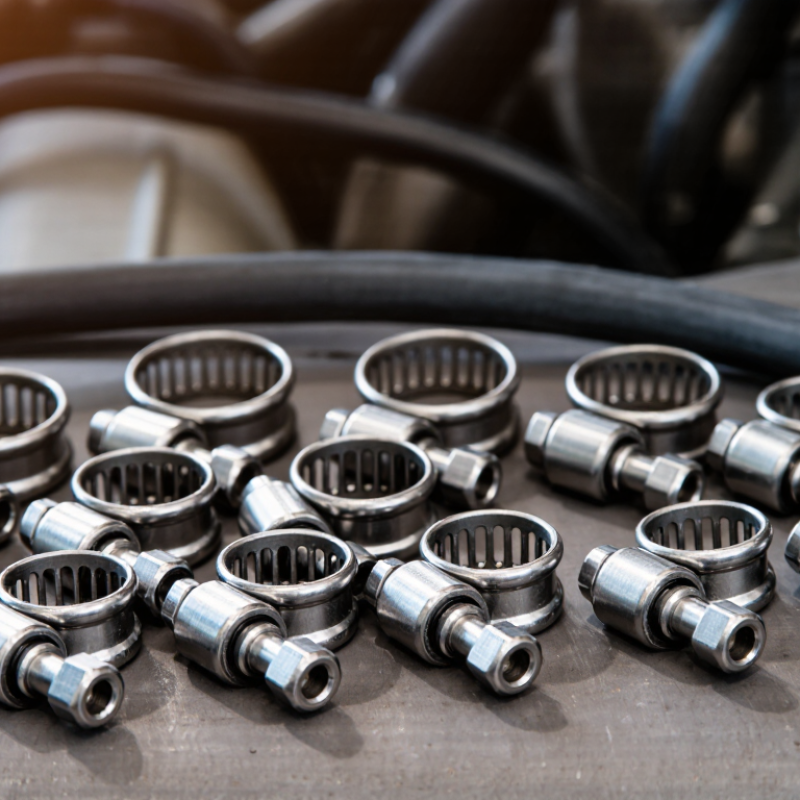
A fuel hose clamp is a fastening device that secures a flexible hose to a pipe, fitting, or fuel system connection. It applies steady pressure around the hose, helping prevent leaks, air entry, and accidental disconnection. Common designs include worm-drive, spring, constant-tension, and fuel-injection clamps. Each design serves different pressure, temperature, and vibration conditions.
These clamps are used in cars, motorcycles, generators, agricultural machines, boats, and small engines. They may appear near fuel tanks, filters, pumps, carburetors, and injection rails. In these areas, heat, vibration, moisture, and chemical exposure can weaken ordinary hardware. Stainless steel construction often improves corrosion resistance, while smooth inner surfaces reduce hose damage. Fit matters. The clamp must match the hose diameter without cutting into the rubber.
In practical maintenance, many failures come from choosing a clamp by appearance alone. A clamp can look strong yet lose tension after repeated heating and cooling. Excessive tightening is another mistake; it may deform the hose and create a hidden leak path. I would check the hose material, working pressure, temperature range, and fuel compatibility before installation. The connection should feel secure, not crushed. Small parts matter. Regular inspection can reveal rust, looseness, cracking, or seepage before the problem becomes serious. Not every “universal” clamp is truly universal. That assumption deserves a second look.
China Top 10 Fuel Hose Clamps Manufacturers?
Choosing a fuel hose clamp manufacturer in China requires more than comparing prices. Check the supplier’s experience with fuel systems, hose materials, and vibration resistance. Ask for production photos, inspection records, and sample reports. A reliable manufacturer should explain material grades, tightening ranges, and corrosion testing clearly. Vague answers are warning signs.
Inspect the factory or request a video audit. Look for organized stamping areas, calibrated torque tools, and separate inspection stations. Ask how workers control sharp edges, uneven bands, and inconsistent screw threads. These small defects can damage a hose during installation. Request traceability from raw steel to packed products. Certifications help, but current test evidence matters more. Sometimes, paperwork looks stronger than the process.
Tips: Test samples with your actual hose size, temperature range, and connection design. Measure clamping force after repeated tightening and vibration. Compare several batches, not one perfect sample. Confirm packaging protects threads from moisture and impact. Discuss lead times, replacement policies, and communication before signing an order. A supplier may pass a factory visit yet struggle with stable output. That is worth considering.
China’s Top 10 Fuel Hose Clamp Manufacturers are increasingly evaluated through production control, material consistency, and verified testing. China Association of Automobile Manufacturers reported 30.16 million vehicles produced in 2023. This scale creates steady demand for reliable fuel-system components.
A serious supplier should document stainless-steel grades, band thickness, torque ranges, and corrosion results. SAE J1508 and DIN 3017 provide useful technical references for clamp design and performance. Factory audits should examine stamping accuracy, edge finishing, heat treatment, and batch traceability. Ask for salt-spray records and dimensional inspection reports. Small details matter.
The strongest candidates usually support prototypes, stable export packaging, and flexible order quantities. Their engineers should explain leakage prevention under vibration, temperature changes, and repeated tightening. Public market reports sometimes estimate different growth rates, so rankings need careful verification. Price alone is a weak indicator. A low-cost clamp may distort the hose or lose tension after thermal cycling. That risk is easy to underestimate.
CAAM also recorded 9.59 million new-energy vehicles sold in 2023. This shift may reduce some traditional fuel-system demand, but internal-combustion vehicles, hybrids, motorcycles, and industrial engines still require secure hose connections. Buyers should compare laboratory evidence with real production experience, not polished catalog language. Some supplier information remains incomplete. That deserves closer review.
The chart presents commonly specified nominal size ranges for automotive fuel hose clamps. These ranges are used to match clamp selection with the outside diameter of fuel hoses; actual availability and compatibility should be confirmed from the manufacturer’s technical specifications.
China Top 10 Fuel Hose Clamps Manufacturers?
Comparison of Materials, Designs, Standards, and Certifications
Material choice changes service life. 304 stainless steel suits ordinary fuel exposure and humid engine bays. 316 stainless steel offers stronger resistance to salt and chemical corrosion. Zinc-plated carbon steel costs less, but coating damage can expose the base metal quickly. OICA recorded 93.5 million motor vehicles produced worldwide in 2023. That volume increases demand for consistent, traceable clamp production. Yet large output does not guarantee reliable sealing.
Design matters equally. Worm-drive clamps provide simple adjustment and broad availability. Constant-tension clamps better follow hose expansion during temperature changes. Spring clamps reduce pressure loss when vibration is severe. T-bolt designs support larger hoses and higher tightening loads, but careless installation may cut soft rubber. SAE J1508 and DIN 3017 offer useful dimensional and performance references. ISO 9001 shows process control, while IATF 16949 indicates stronger automotive quality management. RoHS and REACH evidence helps verify material compliance. Certification alone is not proof of fuel compatibility. Ask for torque records, salt-spray results, vibration testing, and thermal-cycle data.
Tips: Match the clamp to hose hardness, diameter range, fuel type, and temperature. Check the actual band edge. It should feel smooth, not sharp. Request batch traceability and inspection reports. A polished surface can hide weak welding. This is often overlooked.
China’s vehicle market reached 31.28 million sales in 2024, according to the China Association of Automobile Manufacturers. That volume supports a broad fuel hose clamp supply base. However, “top 10” should mean verified capability, not search ranking.
Ask each shortlisted manufacturer for IATF 16949 certification, process-flow records, and recent test reports. Confirm stainless-steel grade, band thickness, torque range, and corrosion performance. SAE J1508 provides useful guidance for clamp dimensions and application testing. Do not accept a generic certificate alone. Check its scope and expiry date.
Request samples from two production batches. Inspect the screw head, band edges, thread engagement, and tightening consistency. A fuel hose connection may sit beside heat, vibration, and spilled chemicals. Small defects matter. According to CAAM, new-energy vehicle sales exceeded 12.8 million units in 2024, changing some hose and thermal-management requirements. Ask whether the factory can adapt materials and tooling without weakening traceability.
Use an RFQ with drawings, annual volume, packaging details, and inspection limits. Compare landed cost, not only unit price. A factory visit can reveal manual deburring, mixed lots, or weak final inspection. Remote audits help, but they cannot show everything. I would also review corrective-action records and sample rejection data. Some suppliers resist sharing them. That hesitation deserves attention. The cheapest quote may become the most expensive mistake.
Comparative sourcing table based on common Chinese manufacturing capabilities and internationally used hose-clamp specifications. Supplier identities are intentionally omitted. All commercial, certification, testing, and capacity information should be verified directly before placing an order.
| Rank | Anonymous Supplier Profile | Primary Manufacturing Strength | Common Clamp Types | Typical Material Options | Typical Size Range | Production Capability | Quality Documents to Request | Suitable Applications | Indicative MOQ | Indicative Lead Time | Buyer Evaluation Focus |
|---|---|---|---|---|---|---|---|---|---|---|---|
| 1 | Supplier Profile A | High-volume stamped band and worm-drive production | Worm-drive Standard band | Galvanized carbon steel; stainless steel 201, 304, or 316 | Approximately 8–280 mm clamping diameter | Automated stamping, forming, screw assembly, and torque testing | Material certificate, dimensional report, torque test, salt-spray result, ISO 9001 certificate | Fuel, coolant, air, water, and general industrial hoses | Commonly 5,000–20,000 pieces per size | About 20–35 working days after approval | Band edge finish, screw engagement, torque consistency, corrosion resistance |
| 2 | Supplier Profile B | Automotive hose-clamp production and assembly control | Worm-drive Constant-tension Spring clamp | Stainless steel 304 or 316; heat-treated spring steel | Approximately 10–220 mm clamping diameter | Progressive stamping, heat treatment, automated assembly, batch traceability | PPAP documents when applicable, material certificate, hardness report, dimensional inspection | Automotive fuel, coolant, vacuum, and emission-control systems | Commonly 3,000–10,000 pieces per specification | About 25–40 working days | Constant-tension performance, spring-back, vibration resistance, lot traceability |
| 3 | Supplier Profile C | Heavy-duty industrial clamps for demanding environments | T-bolt Heavy-duty worm-drive | Stainless steel 304 or 316; zinc-plated high-strength steel | Approximately 17–500 mm clamping diameter | Thick-band forming, welded bridge assembly, torque and vibration testing | Yield-strength data, weld inspection, torque chart, salt-spray test, inspection plan | Heavy trucks, diesel systems, turbocharger hoses, marine and industrial piping | Commonly 1,000–5,000 pieces per size | About 30–45 working days | Bridge weld strength, bolt quality, band thickness, sealing pressure |
| 4 | Supplier Profile D | Small-diameter clamps and customized stamping | Mini worm-drive Ear clamp Oetiker-style ear clamp | Stainless steel 304; galvanized steel; carbon spring steel | Approximately 5–80 mm clamping diameter | Fine blanking, precision stamping, automatic forming, visual inspection | Dimensional report, burr inspection, material composition, compression test | Small fuel lines, motorcycle systems, appliance hoses, pneumatic tubing | Commonly 10,000–50,000 pieces per size | About 15–30 working days | Inner-surface burrs, ear geometry, clamp recovery, size repeatability |
| 5 | Supplier Profile E | Private-label and export-oriented standard clamp production | Worm-drive Perforated band Non-perforated band | Galvanized steel; stainless steel 201, 304, and 316 | Approximately 8–160 mm clamping diameter | Standardized tooling, packaging automation, barcode and carton customization | Pre-shipment inspection, packing list, material certificate, corrosion test | Aftermarket distribution, maintenance, agricultural and general hose assemblies | Commonly 2,000–10,000 pieces per size | About 20–35 working days | Packaging accuracy, mixed-size order control, labeling, export documentation |
| 6 | Supplier Profile F | Corrosion-resistant clamps for marine and chemical environments | Worm-drive T-bolt Heavy-duty band | Stainless steel 316; stainless steel 304 | Approximately 12–400 mm clamping diameter | Stainless-steel forming, passivation control, torque testing, corrosion testing | Grade verification, passivation record, salt-spray report, surface-finish inspection | Marine fuel systems, chemical hoses, outdoor equipment, coastal installations | Commonly 1,000–5,000 pieces per size | About 30–50 working days | Actual steel grade, passivation quality, pitting resistance, galling control |
| 7 | Supplier Profile G | Low-cost standard clamps for high-volume distribution | Standard worm-drive Light-duty clamp | Galvanized carbon steel; stainless steel 201 or 304 | Approximately 8–250 mm clamping diameter | High-speed stamping and assembly with standard tooling | Basic dimensional report, coating-thickness report, incoming-material record | General maintenance, water hoses, low-pressure air and non-critical applications | Commonly 10,000–50,000 pieces per size | About 15–30 working days | Cost versus service life, coating thickness, screw-head quality, defect rate |
| 8 | Supplier Profile H | Customized clamps for special hose profiles and assemblies | Custom band Constant-tension T-bolt | Stainless steel 304 or 316; coated spring steel | Approximately 10–450 mm clamping diameter | Tool design, prototype stamping, fixture development, engineering validation | Drawing approval, first-article report, capability study, functional test report | Specialized fuel, hydraulic, automotive, and industrial hose assemblies | Commonly 500–3,000 pieces for custom items | About 35–60 working days including tooling | Tooling ownership, prototype accuracy, engineering communication, change control |
| 9 | Supplier Profile I | Spring-clamp and constant-force component manufacturing | Spring clamp Constant-tension Ear clamp | Heat-treated carbon spring steel; stainless steel 301 or 304 | Approximately 6–120 mm clamping diameter | Spring forming, heat treatment, load testing, automated dimensional inspection | Hardness report, load-displacement curve, fatigue test, material certificate | Fuel, coolant, HVAC, appliance, and vibration-sensitive hose connections | Commonly 5,000–30,000 pieces per size | About 25–45 working days | Clamp force over temperature, fatigue life, heat-treatment consistency, sharp edges |
| 10 | Supplier Profile J | Small-batch export production and rapid sample development | Worm-drive Mini clamp Custom clamp | Stainless steel 304; stainless steel 316; zinc-plated steel | Approximately 6–300 mm clamping diameter | Flexible tooling, sample-room support, mixed-size production, export packing | Sample inspection report, dimensional drawings, material declaration, packing inspection | Prototyping, aftermarket products, small and medium industrial orders | Commonly 500–5,000 pieces per size | About 15–35 working days after sample approval | Sample-to-mass-production consistency, minimum order flexibility, communication speed |
304 stainless steel suits ordinary fuel exposure and humid engine bays. It offers practical corrosion resistance. Not perfect for salty conditions.
Choose 316 stainless steel near saltwater, road chemicals, or aggressive corrosion. It usually resists chemical attack better. Cost increases.
No. They cost less, but coating damage can expose the base metal quickly. Inspect scratches carefully.
Constant-tension clamps follow hose expansion during heating and cooling. Spring clamps also help during strong vibration. Fit matters more than appearance.
T-bolt clamps suit larger hoses and higher tightening loads. Careless installation can cut soft rubber. Use controlled tightening.
Request applicable dimensional standards, quality-system evidence, torque records, and test reports. Check certification scope and expiry dates. Generic certificates are weak evidence.
Examine the screw head, band edges, thread engagement, and tightening consistency. The band edge should feel smooth, not sharp. Check two production batches.
Include drawings, hose diameter, material grade, annual volume, packaging, and inspection limits. Compare landed cost, not unit price. Cheap quotes can mislead.
Ask for salt-spray, vibration, thermal-cycle, and corrosion data. Also request batch traceability. A polished surface can hide weak welding.
A visit may reveal manual deburring, mixed lots, or weak final inspection. Remote audits help, but show less. I would review corrective-action records too.
This guide explores China’s top 10 Fuel Hose Clamps manufacturers and explains how to identify reliable suppliers for automotive, industrial, agricultural, and fluid-transfer applications. It begins by describing what fuel hose clamps are, how they secure hoses and prevent leaks, and where different designs are commonly used. The article then presents practical criteria for evaluating Chinese manufacturers, including production capacity, quality control, customization support, delivery performance, and technical service.
It also compares common materials, clamp structures, size ranges, surface treatments, and relevant quality or certification requirements, helping buyers understand how product choices affect durability, corrosion resistance, sealing performance, and cost. Finally, the guide outlines a clear sourcing process, from defining operating conditions and specifications to requesting samples, verifying factory capabilities, reviewing test reports, and negotiating reliable supply terms. The goal is to help international buyers select suitable Fuel Hose Clamps and establish stable, professional cooperation with qualified Chinese manufacturers.

Mika Clamp