Choosing a dependable Hose Pipe Clamp manufacturer takes more than comparing catalog prices. Clamp performance depends on material, band thickness, screw design, and the hose’s working conditions. A part that looks sturdy on a screen may behave differently under vibration, pressure changes, or repeated maintenance. Small details matter.
This guide introduces ten manufacturers serving different markets and application needs. It considers product range, manufacturing capabilities, quality documentation, customization, and customer support. These factors can help buyers build a shortlist, but they do not replace testing or supplier checks. Fit is not universal. A clamp suited to a garden hose may not be appropriate for an industrial assembly. Confirm dimensions, material compatibility, operating requirements, and installation guidance before placing an order.
Company claims and product specifications should be checked against current documentation, since offerings can change. Where public information is limited, that limitation deserves attention rather than guesswork. The right supplier is not always the largest or cheapest; dependable communication and consistent specifications can matter just as much. This overview is a starting point, not a final verdict. Use it to compare options, ask precise questions, and identify which manufacturers merit closer evaluation for your project.
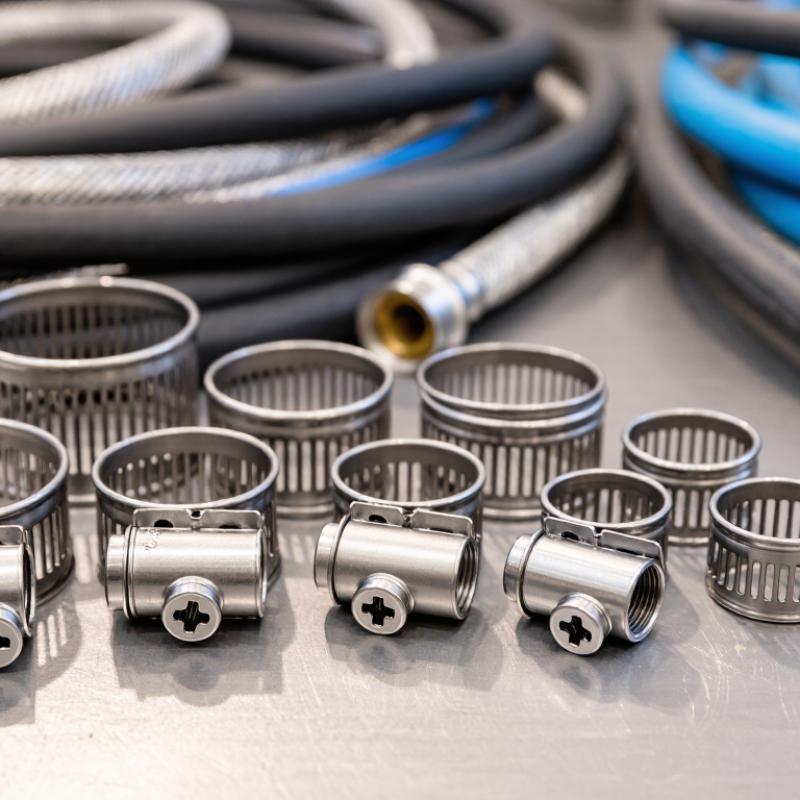
A hose pipe clamp is a metal or plastic band that holds a hose securely over a fitting. It helps reduce leaks and prevents the hose from slipping when pressure or movement increases. You may see clamps on garden hoses, vehicle cooling lines, and workshop equipment. The right type depends on the hose material, fitting shape, and operating conditions.
In a screw-type clamp, turning the screw draws the band tighter around the hose. The band presses the hose against the fitting, creating a firm seal.
Spring-style clamps use their own tension to maintain pressure as the hose expands or contracts. Simple parts, but sizing matters. A clamp that is too large may not tighten evenly; one that is too small can damage the hose.
Tips: Measure the hose’s outside diameter while it sits on the fitting. Tighten gradually, then check for leaks during use. Avoid crushing soft hose walls.
In practice, a clamp can look secure and still be poorly positioned. Keep it behind the fitting’s raised lip, with the band sitting flat and clear of sharp edges. For soft or thin-walled hoses, even pressure is especially important. Over-tightening may cut into the material or restrict flow. Check the connection again after the first use, since some hoses settle once pressure and temperature change.
When evaluating Chinese hose pipe clamp manufacturers, look beyond catalogue images. Request drawings showing band width, thickness, screw dimensions, and tolerance ranges. Then compare these with measured samples. A bright finish proves little.
World Steel Association’s World Steel in Figures 2024 reports that China produced 1,019.1 million tonnes of crude steel in 2023, out of 1,888.2 million tonnes worldwide. That scale does not guarantee clamp-grade material. Ask suppliers to trace steel certificates to production batches and identify the alloy grade. Check whether forming, welding, and passivation are controlled in-house or outsourced. Outsourcing is not automatically a problem, but weak traceability is.
Quality systems matter, too. The ISO Survey 2022 recorded 1,265,216 ISO 9001 certificates worldwide. This is a broad indicator, not proof that a particular clamp performs well. Ask for current certification scope, inspection records, and test results tied to the product. Useful checks include clamp torque, dimensional consistency, and corrosion testing under a stated method. Test against your actual hose and operating conditions. A polished brochure is not evidence. I would still verify repeatability across several batches; one good sample can be misleading.
Suggested procurement scorecard weights (%)
Material and corrosion resistance, dimensional consistency, and performance under pressure and vibration receive the highest suggested weights. These are buyer-defined evaluation weights, not measured market statistics or ratings of individual manufacturers; adjust them to suit the application and applicable requirements.
China’s top hose pipe clamp manufacturer profiles are most useful when they show what each factory actually makes. Compare specialists in stamped steel bands, worm-drive clamps, T-bolt designs, constant-tension parts, and stainless-steel assemblies. Other profiles may focus on automotive, plumbing, irrigation, export orders, or custom production. Look for clear details on material grades, clamp ranges, production equipment, and inspection methods—not broad claims about quality.
UNIDO’s International Yearbook of Industrial Statistics 2024 places China at about 30% of global manufacturing value added in 2022. This signals a substantial manufacturing base, but it is not clamp-specific evidence. A reliable profile should still state how samples are tested, how dimensions are checked, and whether corrosion resistance is verified. Ask for test conditions and tolerances. A polished factory photo proves very little. One limitation: public profiles often leave inspection details vague, so buyers may need to request them directly.
Tip: Compare like with like. Check band width, screw material, tightening range, and test results against your operating conditions. A clamp that fits a smooth sample may slip on a vibrating hose.
Choosing among the China top 10 hose pipe clamp manufacturers means looking beyond price. Compare clamp styles, band width, screw design, and size range against the hose’s pressure and vibration conditions. Stainless steel is common where moisture resistance matters; carbon steel may suit less demanding environments. The International Stainless Steel Forum reported global stainless steel crude production of 58.4 million tonnes in 2023, a useful sign of the material’s broad industrial role. That figure does not, by itself, prove a clamp’s corrosion performance. Ask for the specific steel grade and test conditions.
Manufacturing capability shows up in details you can inspect. Look for consistent band edges, smooth screw engagement, and repeatable torque results across sample batches. Ask whether the supplier controls forming, heat treatment, welding, and inspection in-house, or relies on outside processes. Request material certificates, dimensional inspection records, and corrosion-test results where relevant. A polished sample is not enough. Batch consistency can still vary.
Tips: Match clamp material to the hose and environment, then confirm dimensions with a drawing or sample. Ask how production defects are tracked and corrected. One caveat: catalog specifications may not reflect custom orders, so verify the exact configuration before approving production.
Hose pipe clamps serve different duties across automotive cooling lines, irrigation systems, workshop air hoses, and industrial fluid connections. Select a clamp for the hose’s outside diameter when fitted, not only its nominal size. A coolant hose beside an engine faces heat and vibration; a garden line may need only modest tightening. The difference matters. Check working pressure, temperature range, fluid compatibility, and expected movement before requesting quotations. An oversized clamp can leave a leak path, while excessive tightening may damage soft hose material.
When comparing suppliers in China, ask for clamp material, band width, screw details, dimensional tolerances, and corrosion-test information. Stainless steel can help in damp settings, but the exact grade and assembly still matter. Request samples and test them on your own hose, using a measured tightening method. Look for smooth band edges, even screw engagement, and repeatable fit across several pieces. Small details show. Confirm packaging, inspection records, lead time, and whether production changes will be communicated. A catalogue dimension can look convincing, yet fit may vary between hose constructions. That is easy to overlook. Keep a written specification and approve a sample before placing a larger order.
| No. | Clamp Type | Typical Applications | Common Material Options | Key Sourcing Factors |
|---|---|---|---|---|
| 1 | Worm-drive clamp | General-purpose connections in automotive, plumbing, irrigation, and light industrial hose assemblies. | Stainless steel, zinc-plated carbon steel, or mixed-material construction. | Check the usable diameter range, band width, band-edge finish, screw material, and corrosion environment. Confirm that the band suits the hose and fitting. |
| 2 | T-bolt clamp | Large-diameter or demanding connections, including charge-air, coolant, and industrial hoses where a robust clamping arrangement is required. | Stainless steel or plated steel, often with a T-bolt and locking nut. | Verify diameter range, band width and thickness, bolt size, tightening method, and compatibility with the hose manufacturer’s pressure and installation requirements. |
| 3 | Constant-tension spring clamp | Automotive cooling and other hose systems that experience temperature-related changes in hose dimensions. | Spring steel, commonly with a corrosion-protective finish. | Check operating-temperature limits, spring force, clamp range, corrosion protection, and whether the design is intended for the specific hose and joint. |
| 4 | Ear clamp | Compact, permanent connections in automotive, appliance, and fluid-line assemblies. | Stainless steel or coated steel. | Confirm the closed diameter, ear dimensions, material thickness, required installation tool, and whether the connection needs to be removable. |
| 5 | Stepless ear clamp | Applications requiring a continuous clamping band around small hoses, such as selected automotive and appliance connections. | Stainless steel or corrosion-protected steel. | Ask about band width, material thickness, diameter tolerance, installation-tool requirements, and sample performance on the actual hose assembly. |
| 6 | Double-wire clamp | Flexible hose connections in appliances, low-pressure fluid lines, and selected air or ventilation systems. | Plated carbon steel or stainless steel wire. | Check wire diameter, clamp range, opening method, corrosion resistance, and suitability for the operating pressure and hose construction. |
| 7 | Quick-release clamp | Serviceable hose connections that need frequent inspection or removal, including some industrial and ventilation equipment. | Stainless steel or plated steel, with a lever or quick-release mechanism. | Evaluate locking security, repeated-cycle durability, usable diameter range, vibration exposure, and the space required to operate the release mechanism. |
| 8 | V-band clamp | Joining flanged components, such as selected exhaust, turbocharger, and ducting assemblies; it is not a general-purpose hose-band clamp. | Stainless steel or heat-resistant steel, depending on service conditions. | Match the clamp profile and diameter to the mating flanges. Check temperature, material grade, latch or fastener design, and the assembly supplier’s requirements. |
| 9 | Heavy-duty bridge clamp | Large or reinforced hoses where a bridge or saddle can help span a hose bead or joint feature. | Stainless steel or plated steel, with a bridge component suited to the assembly. | Confirm bridge geometry, diameter range, band strength, fastener specification, and fit against the hose bead and connector dimensions. |
| 10 | Perforated band clamp | General-purpose fastening where an adjustable band is useful, including some ducting, light industrial, and utility applications. | Stainless steel or zinc-plated carbon steel. | Inspect perforation and band-edge finish, screw engagement, material and coating, diameter range, and whether perforations could damage or deform the hose. |
Selection note: Clamp suitability depends on the hose material, outside diameter, fitting geometry, operating pressure and temperature, vibration, and exposure to chemicals or moisture. Confirm dimensions and performance requirements with samples and application-specific testing before ordering.
Compare stamped steel bands, worm-drive clamps, T-bolt designs, constant-tension parts, and stainless-steel assemblies. Each suits different needs.
Look for materials, size ranges, production equipment, and inspection methods. Broad quality claims reveal little.
Stainless steel may suit damp environments. Carbon steel may work in less demanding conditions. Check the exact grade.
Compare band width, screw material, tightening range, pressure, and vibration conditions. A close fit matters.
Inspect band edges and screw engagement. Ask for repeatable torque results across sample batches. One sample is not enough.
No. Photos prove little. Request dimensional records, test conditions, tolerances, and relevant corrosion results.
No. National manufacturing figures do not verify one factory’s products. Ask how samples are tested and dimensions checked.
Check the exact configuration against a drawing or sample. Catalog details may not match custom production, so verify carefully. I might still miss a detail.
This article explains what a Hose Pipe Clamp is and how it creates a secure connection by tightening around a hose, helping reduce movement and leakage when correctly selected and installed. It also outlines practical criteria for evaluating Chinese manufacturers, including production experience, quality-control procedures, material options, manufacturing capacity, customization support, and communication reliability.
The guide compares the capabilities of ten manufacturers without focusing on brand promotion, and surveys common clamp designs, materials, and production methods. It concludes with sourcing considerations such as hose and fitting dimensions, operating conditions, corrosion resistance, required clamping force, order quantities, and delivery expectations. By weighing these factors together, buyers can identify suitable products and suppliers for their intended applications while making more informed purchasing decisions.

Mika Clamp