Choosing the right clamp for a fuel line is a small decision with serious consequences. Fuel Injection Hose Clamps must hold steady pressure without cutting, loosening, or damaging the hose. A poor clamp can leave a wet fuel mark near the connection. That smell should never be ignored.
In practical hose replacement work, I have found that clamp design matters as much as material quality. Traditional worm-drive clamps can work in some applications, but their perforated bands may bite into soft fuel hose. EFI clamps usually spread pressure more evenly. Spring clamps can maintain tension during temperature changes. Constant-tension clamps are also useful when hoses expand and contract repeatedly.
This guide examines seven highly regarded Fuel Injection Hose Clamps for fuel lines. Each option is considered for grip, corrosion resistance, installation control, hose protection, and compatibility with modern fuel systems. The comparison also considers tight engine bays, limited tool access, and repeated maintenance. Small details matter. A smooth inner band can prevent a hidden cut. A correctly sized clamp can stop seepage without crushing the hose.
Not every clamp suits every vehicle. Always verify the hose type, outer diameter, fuel compatibility, and manufacturer recommendations before installation. A clamp may look strong yet fit poorly. That is an easy mistake to make. I would also recheck the connection after the first heat cycle, because initial confidence can be misleading. The best choice is not always the most expensive product. It is the clamp that delivers secure, even pressure for the specific fuel line and operating conditions.
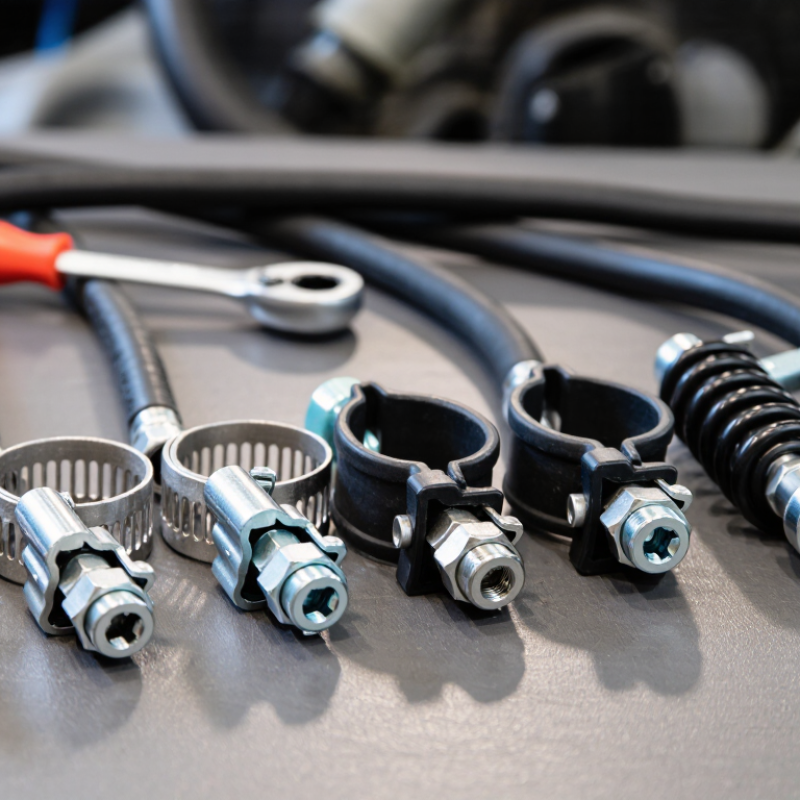
Fuel injection hose clamps must match the hose, fitting, and operating pressure. A clamp that works on a low-pressure fuel line may fail on an injection system. The seven practical choices include smooth-band clamps, stepless ear clamps, constant-tension clamps, spring clamps, crimp clamps, narrow fuel-injection screw clamps, and reinforced band clamps. Smooth inner surfaces matter most. Perforated hardware can bite into rubber and create small leaks.
Check the hose’s outside diameter before buying. Measure it over the fitting, not from the loose hose end. The clamp should sit behind the fitting’s raised bead without covering the hose edge. Fuel-resistant rubber needs a compatible clamp that applies even pressure. Soft hose can deform under excessive tightening. I have seen a dry-looking connection leak after the engine warmed up.
Tips: Inspect the hose for swelling, cracks, or a glossy surface. Replace damaged hose instead of tightening harder. Use a clamp designed for fuel injection, not a general-purpose clamp with sharp slots. Position the clamp squarely, then tighten it only until the hose seals. Do not crush the fitting. After installation, check for dampness, odor, or movement around the connection. A small inspection light helps. Cold testing is not enough; temperature changes can reveal poor compatibility. Some clamps seem secure but loosen after vibration, so recheck the connection during routine maintenance.
| No. | Clamp Type | Best Application | Compatible Hose Construction | Common Materials | Main Advantages | Limitations and Selection Notes |
|---|---|---|---|---|---|---|
| 1 | Fuel-injection smooth-band screw clamp | Serviceable connections on pressurized fuel-injection hose when a reusable clamp is required. | Fuel-injection hose with a smooth outer cover and a correctly sized inside diameter. | Stainless steel band, housing, and screw; corrosion-resistant grades are preferred near fuel and moisture. | Perforation-free band reduces localized cutting; adjustable and removable; good access for routine servicing. | Select only a clamp specifically rated for fuel-injection service and the hose's working pressure. Do not overtighten, as excessive torque can damage the hose. |
| 2 | Constant-tension spring clamp | Fuel lines exposed to vibration or temperature changes, where the joint may expand and contract. | Flexible rubber or elastomer fuel hose designed for spring-clamp use. | Spring-tempered carbon steel or stainless steel. | Maintains radial tension as the hose relaxes; has no screw threads that can strip; compact around bends. | Requires correct outside-diameter sizing and access for clamp pliers. Verify that the hose manufacturer permits this clamp style. |
| 3 | Single-ear crimp clamp | Permanent or semi-permanent factory-style fuel hose assemblies. | Fuel hose with a suitable smooth outer surface and a fixed barb connection. | Ductile or stainless steel with a formed crimp ear. | Provides an even circumferential seal without screw threads; low profile and resistant to loosening from vibration. | Usually requires a dedicated crimping tool and is not intended for repeated reuse. The clamp must be positioned correctly before crimping. |
| 4 | Double-ear crimp clamp | Connections needing a broader, more uniform clamping load than a single-ear design. | Flexible fuel hose installed over a compatible barb, especially where sealing consistency is important. | Stainless steel or plated steel. | Two crimp points distribute force around more of the circumference and provide a compact permanent joint. | Not normally reusable; removal generally requires cutting the clamp. Correct sizing is essential because over-crimping may constrict the hose. |
| 5 | Low-profile narrow-band fuel clamp | Tight engine compartments and connections located close to fittings or adjacent components. | Fuel hose with an even outside diameter and sufficient wall strength for localized compression. | Stainless steel or plated steel with a smooth inner band. | Needs less clearance than a wide clamp and can be positioned close to the end of the hose. | A narrow band concentrates load over a smaller area. Use only when the clamp is rated for the hose and fuel-system pressure. |
| 6 | Heavy-duty T-bolt clamp | Large-diameter fuel or vapor hoses requiring high mechanical retention and a robust fastening system. | Reinforced hose with a relatively large outside diameter; suitability must be confirmed for the specific fuel system. | Stainless steel band, bridge, bolt, and locknut. | High tightening capability, strong retention, and a wide band that can distribute load over a larger area. | Often oversized for ordinary automotive fuel hose. It may damage small or soft hose if over-tightened and may require extra installation clearance. |
| 7 | Fuel-rated worm-drive clamp with solid band | General service applications where adjustability and easy removal are more important than a permanent crimped joint. | Fuel-compatible rubber or elastomer hose with adequate wall thickness and a smooth exterior. | Stainless steel or corrosion-resistant plated steel; the band should be solid rather than perforated. | Easy to install with a screwdriver or nut driver; adjustable over a useful diameter range; reusable when undamaged. | Do not substitute a generic perforated utility clamp on a pressurized fuel line. Check torque, pressure rating, temperature range, and fuel compatibility before use. |
Pressure, diameter, and hose material must work together. A low-pressure clamp may fail under injection pressure. A perfect clamp cannot fix the wrong hose.
Measure the hose outside diameter over the fitting. Do not measure the loose hose end. Choose a clamp range near its middle. Not at the limit.
Choose smooth inner surfaces and even pressure distribution. Perforated clamps can bite into rubber. Sharp slots may create small leaks.
Push the hose fully against the fitting stop. Place the clamp behind the raised bead. Do not place it over the hose edge.
Tighten gradually until the hose seals evenly. Stop before crushing or cutting the rubber. Over-tightening can cause later leaks.
Look for swelling, cracks, hardening, glossiness, or fuel odor. Replace damaged hose. Tightening harder is not a repair.
Yes. Heat can reveal a leak that cold testing misses. Check for dampness after a brief system test. Stop immediately if fuel appears.
Work on a cool engine in a ventilated area. Keep sparks and hot lights away. Recheck the clamp after cooling and during maintenance.
Stainless steel generally resists moisture, road salt, and fuel vapors well. Coated steel can corrode after scratches. Poorly made material may still lose strength.
Stop and correct the installation. Do not add another clamp automatically. Check the hose, fitting, position, and pressure rating again. Small detail, big consequence.
Choosing the right Fuel Injection Hose Clamps is essential for creating a secure, leak-resistant connection in modern fuel systems. This guide explains the basics of clamp design and fuel-line compatibility, then compares seven clamp types suited to different applications, including standard fuel injection, high-pressure, compact, and service-friendly installations. It also examines how material quality, clamp size, corrosion resistance, and sealing performance affect reliability and hose protection.
Readers will learn a practical step-by-step installation process, from selecting the correct diameter to positioning and tightening the clamp without damaging the hose. The guide also highlights essential safety checks, common mistakes such as over-tightening or using incompatible clamps, and maintenance practices that help identify wear, corrosion, loosening, or fuel leakage early. With careful selection and regular inspection, the proper clamp can support dependable fuel-line performance and longer service life.

 Mika Clamp