Choosing the right T Bolt Hose Clamp in 2026 requires more than comparing prices or polished product photos. Global buyers need secure sealing, stable torque, corrosion resistance, and dependable supply. A clamp used on a heavy-duty truck hose faces different demands from one installed on food-processing equipment or industrial machinery.
This guide examines common T Bolt Hose Clamp types, including standard stainless steel designs, wide-band models, spring-loaded versions, and clamps with bridge-free interiors. It considers band width, bolt diameter, nut quality, welding strength, and adjustment range. These details matter when a hose expands, vibrates, or operates near heat. A properly selected clamp should hold firmly without cutting into the hose wall. Small differences can prevent costly leakage.
Real-world purchasing also involves material verification, sample testing, packaging, and supplier communication. Stainless steel may perform well, but its grade and manufacturing quality still require confirmation. Ask for dimensional drawings, torque guidance, inspection records, and clear product tolerances. Do not trust every catalog claim. A useful test is simple: fit the clamp on the actual hose, apply the recommended torque, and inspect it after pressure and vibration exposure. No shortlist is perfect. Conditions vary between regions, industries, and installation teams. This review offers a practical comparison, while recognizing that the lowest price may not deliver the lowest lifetime cost. Reliability begins with evidence, not assumptions.
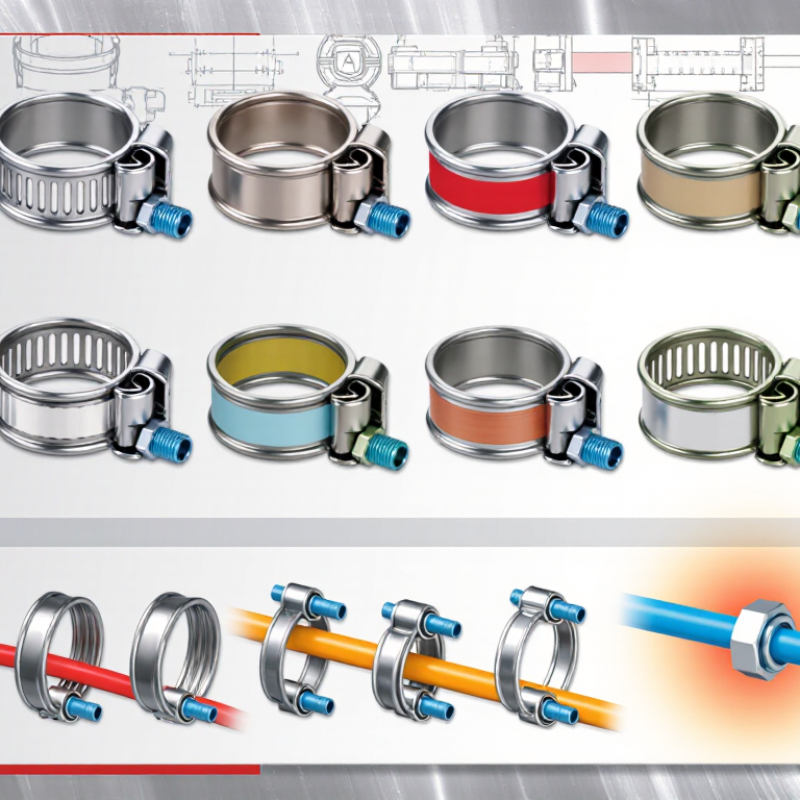
T-bolt clamps differ mainly through band, bridge, and liner design. Their selection should follow pressure, temperature, hose material, and service movement. Grand View Research’s 2024 industrial hose report estimates the global market at roughly USD 13 billion in 2023. That scale reflects demand from chemical processing, construction, food production, and heavy equipment.
The smooth full-band T-bolt clamp is the basic choice. Its continuous stainless-steel band spreads radial load around soft silicone or rubber hoses. A wide-band version adds contact area for large-diameter connections. It reduces local cutting, but may require more installation clearance.
The bridge-type clamp uses a reinforced bridge beneath the bolt housing. This design handles stronger tightening forces and helps prevent band distortion near the joint. It suits rigid ducts and high-vibration machinery.
The lined T-bolt clamp adds an inner sleeve under the band. The liner covers perforations and protects thin hose walls from extrusion. This detail matters with pressurized air, coolant, and flexible composite hoses.
SAE J1508 provides recognized guidance for hose-clamp performance, while ISO 6803 covers hydraulic hose impulse testing. These references do not replace application testing. They support better screening. One practical mistake is choosing by diameter alone. I have seen a correctly sized clamp damage a soft hose after excessive torque. Torque control, band width, and post-installation inspection still deserve attention.
For 2026 T-bolt hose clamp purchasing, stainless grade matters more than polished appearance.
ISO 9227:2022 specifies neutral salt spray using 5% sodium chloride, 35°C, and controlled pH. These conditions help compare corrosion resistance. They do not predict exact field life. That limitation is often overlooked.
Industry guidance from the International Stainless Steel Forum and the Nickel Institute uses PREN as a useful screening indicator. Typical 304 stainless steel has a PREN near 18. Typical 316 stainless steel reaches approximately 24, because molybdenum improves chloride resistance.
The difference looks small on paper. It is not small near seawater, road salt, or humid washdown areas. ISO 9227 comparisons generally show delayed red-rust development for 316, although results vary with surface finish and fastener contamination.
Choose 304 for indoor machinery, dry packaging lines, and mild agricultural environments.
Choose 316 when clamps face salt spray, coastal air, or repeated chemical cleaning.
A T-bolt’s exposed threads and welded bridge deserve extra attention. Ask suppliers for the steel grade, salt-spray exposure duration, test method, and failure criterion.
“Passed” is incomplete without those details.
One imperfect assumption remains: laboratory spray is harsher in some ways, yet less realistic in others. Crevices, trapped moisture, and installation scratches can defeat even 316 stainless steel.
For global buyers, T-bolt hose clamps should be evaluated through controlled installation torque. A practical 5–15 N·m benchmark covers many SAE J1508 applications, from coolant lines to industrial air circuits. SAE J1508 provides clamp and hose-interface guidance, but it does not create one universal torque value. That distinction matters.
Low torque can leave a visible leak path. Excessive torque may crush soft hose walls or distort fittings. A 5–8 N·m setting often suits smaller, flexible hose assemblies. Larger diameters, reinforced hose, or higher pressure service may require 10–15 N·m. These values need confirmation through assembly trials, not guesswork. A calibrated torque wrench should record each installation.
The SAE J1508 framework should be read with pressure, temperature, and hose construction data. ASTM D380 testing practices can help verify hose performance before clamp selection. ISO 9227 corrosion-test data also supports screening for salt-exposed applications, especially where stainless hardware is specified. Industry purchasing reports published in 2024 continue to identify leakage prevention and corrosion resistance as major clamp-selection factors. The evidence is useful, though market reports rarely explain actual workshop torque variation.
I have seen torque marks used as proof of quality. They are not enough. Surface contamination, uneven bolt loading, and hose relaxation can still change sealing pressure. A 15 N·m target may look professional, yet become wrong for a thin-wall hose. Application testing remains necessary. Calibration records should travel with the assembly.
Benchmark installation torque across SAE J1508 applications
The chart compares representative installation torque benchmarks within the 5–15 N·m range for common T-bolt clamp configurations. Actual torque depends on clamp size, bolt diameter, thread condition, gasket compression, hose material, and the applicable installation specification. Always verify the final value against the clamp supplier’s technical data and the equipment manufacturer’s requirements.
2026 Best T Bolt Hose Clamp Types for Global Buyers
Temperature changes can loosen a hose joint through repeated expansion and contraction. Spring-loaded T-bolt clamps help maintain pressure during this movement. They suit coolant lines, air systems, and machinery exposed to vibration. Their built-in spring action can reduce retightening work. That matters in remote installations. Small detail, big consequence.
For service from −40°C to 150°C, confirm every material before ordering. Stainless steel resists corrosion in wet environments. The spring alloy must also retain force across the full temperature range. Check the hose compound, pressure rating, band width, and bolt size together. A narrow band may cut soft rubber. A weak spring may lose sealing force at high heat. Not every “heavy-duty” clamp is suitable for continuous 150°C service.
Heavy-duty T-bolt clamps provide stronger mechanical loading than common worm-drive designs. They work well on thick-wall hoses, intake pipes, and high-pressure connections. Use a calibrated torque wrench during installation. Over-tightening can crush the hose and create a hidden leak path. Under-tightening allows movement. I have seen both problems after rushed field repairs. The fitting looked secure, but thermal cycling exposed the mistake. Validate the selected clamp with pressure testing, vibration checks, and repeated temperature cycles. A practical trial may reveal weaknesses that a catalog table misses.
| Clamp Type | Typical Band Width | Typical Band Thickness | Common Bolt Size | Typical Clamping Diameter Range | Recommended Service Temperature* | Best-Fit Application | Selection and Installation Notes |
|---|---|---|---|---|---|---|---|
| Spring-Loaded T-Bolt Clamp | 19–25 mm | 0.6–0.8 mm | M6 or 1/4 in | 38–165 mm | −40 to 150°C | Cooling systems Air ducts Thermal cycling | The spring compensates for hose contraction and expansion during temperature changes. Confirm that the spring remains within its designed compression range at the selected diameter. |
| Standard Heavy-Duty T-Bolt Clamp | 19–25 mm | 0.8–1.0 mm | M6 or M8 | 25–252 mm | −40 to 150°C | Industrial hoses Turbo-air hoses General service | Provides higher and more uniform circumferential loading than many worm-drive designs. Use a calibrated torque value specified for the clamp and hose assembly. |
| Wide-Band Heavy-Duty T-Bolt Clamp | 25–32 mm | 0.8–1.2 mm | M8 | 50–406 mm | −40 to 150°C | Large hoses Low-pressure ducts Large-diameter couplings | The wider band distributes load over a larger hose area and can reduce local indentation. Check hose reinforcement and available radial clearance before installation. |
| Lined T-Bolt Clamp | 19–25 mm | 0.6–1.0 mm | M6 or M8 | 38–252 mm | −40 to 150°C | Soft silicone hoses Thin-wall hoses Vibration-sensitive assemblies | The inner liner helps shield soft hose materials from the band edge. Verify liner material compatibility with coolant, oil, fuel vapor, and cleaning chemicals. |
| Double T-Bolt Clamp | 2 × 19–25 mm | 0.6–1.0 mm per band | M6 or M8 per band | 38–252 mm | −40 to 150°C | High-sealing joints Couplers Hose ends near fittings | Two bands increase the sealing area and resistance to hose movement. Position the bands evenly on the coupling and avoid placing either band directly over a hose bead. |
| Constant-Tension Heavy-Duty T-Bolt Clamp | 19–25 mm | 0.8–1.0 mm | M6 or M8 with spring pack | 50–252 mm | −40 to 150°C | Engine compartments Vibration Repeated heat cycles | Suitable where joint movement and thermal cycling can relax a fixed-tension clamp. Spring travel, bolt alignment, and maximum installation torque must be checked together. |
| Corrosion-Resistant T-Bolt Clamp | 19–25 mm | 0.6–1.0 mm | M6 or M8 | 25–252 mm | −40 to 150°C | Outdoor equipment Marine atmospheres Chemical washdown | Select stainless construction according to the exposure and galvanic environment. Corrosion resistance of the bolt, nut, spring, band, and weld should be evaluated as a complete assembly. |
For global buyers, T-bolt hose clamp selection should begin with evidence, not appearance. A polished band means little if the supplier cannot provide material records, test conditions, and traceable inspection data. When a clamp is advertised against DIN 3017, verify the exact scope. The standard reference may not cover every T-bolt design or application. Check band thickness, bolt construction, weld quality, and adjustment range.
RoHS and REACH documentation also requires careful review. Ask for current declarations covering the clamp, plating, elastomer insert, and packaging where relevant. A simple compliance statement can be incomplete. Confirm whether substances of very high concern are addressed and whether laboratory reports support the declaration. These details matter when products enter several markets with different customer audits.
Pressure ratings need even more caution. The real limit depends on hose material, diameter, temperature, pulsation, torque, and installation quality. Request test results showing the assembly used, not only the clamp’s maximum figure. A 60 mm clamp on reinforced hydraulic hose behaves differently from one on a soft silicone tube. Installation records should include tightening torque and gap position. Field experience shows that uneven tightening can create leakage before the rated pressure is reached. No rating is universal. Reviewers should challenge unclear data, even when the supplier seems technically confident. That extra question may prevent a costly return.
The main types differ by band, bridge, and liner design. Smooth full-band clamps spread load around soft hoses. Wide-band versions add contact area. Bridge-type clamps support stronger tightening forces. Lined clamps protect thin hose walls.
Choose one for soft silicone or rubber hoses. Its continuous band distributes radial pressure evenly. This reduces local cutting. Allow enough installation clearance around the connection. Diameter alone is not enough.
A wide band covers more hose surface. It helps reduce pressure concentration on large-diameter connections. This can protect soft rubber from damage. However, the wider body needs more space. Measure the surrounding equipment before ordering.
A reinforced bridge supports the band near the bolt housing. It helps prevent distortion during high tightening loads. This design suits rigid ducts and vibrating machinery. Check the joint after operation begins. Vibration can reveal hidden weaknesses.
An inner liner covers band perforations and sharp contact areas. It protects thin hose walls from extrusion. This matters for pressurized air, coolant, and composite hoses. The hose may look fine at installation. Pressure can expose damage later.
Spring-loaded clamps help maintain sealing pressure during thermal movement. They suit coolant lines, air systems, and vibrating equipment. Their spring action may reduce retightening work. Small detail. Confirm that the spring keeps force across the full temperature range.
Not automatically. Check the steel, spring alloy, hose compound, pressure rating, and bolt size. For service near 150°C, every material needs verification. Cold conditions near −40°C also affect performance. The label alone may mislead.
Use a calibrated torque wrench during installation. Over-tightening can crush the hose and create a hidden leak path. Under-tightening allows movement and leakage. Inspect the joint after pressure testing and temperature cycling. A catalog table cannot replace practical testing.
This guide helps global buyers select the right T Bolt Hose Clamp by examining four main designs: band construction, bridge shape, and liner configuration. It explains how standard, spring-loaded, heavy-duty, and lined types support different sealing and vibration requirements. The comparison of 304 and 316 stainless steel focuses on corrosion performance under ISO 9227 testing, helping buyers choose materials for freshwater, coastal, chemical, and humid environments.
The article also reviews installation torque targets from 5–15 N·m for applications aligned with SAE J1508 practices, emphasizing consistent tightening without damaging hoses or fittings. Service temperature guidance from −40°C to 150°C helps match spring-loaded and heavy-duty clamps to demanding operating conditions. Finally, it outlines practical checks for DIN 3017 alignment, RoHS and REACH documentation, pressure ratings, traceability, and application-specific testing before approving a T Bolt Hose Clamp for international sales.

Mika Clamp